Weeknotes: My Own Coding Agent Extensions and VoiceScribe Going Local-Only
Didn’t get much time to delve into side projects this week - but what I did get to was a re-architecture of My Own Coding Agent around extensions, and pulling VoiceScribe back to a local-only pipeline.
My Own Coding Agent
I had a chance this week to do a fairly comprehensive re-architecture and redesign of some of the core bits of My Own Coding Agent. The inspiration again came from Pi and its extensible nature - it keeps its core deliberately minimal and pushes things like sub-agents, plan mode, and MCP out into a TypeScript extension API, so the agent fits your workflow rather than dictating one. That’s a beautiful thing about Pi, and I wanted to incorporate that thinking at a fundamental level here.
I wasn’t too far off already, but the boundaries needed cleaning up. What I landed on was a neutral hook seam at the delivery boundary, which lets me provide sub-agents, plan mode, and MCP adaption at an extension level without polluting the agent core. The quick feedback loop of flexing the extension API with several examples that pushed on different capabilities helped greatly with the overall design I landed on.
The other interesting part was the user-interface layer. UI can be quite a leaky concern - you can really get coupled to the specific surface you’re rendering to. I landed on optional extension UI bindings, with an escape hatch for specific needs, providing clear prompt / confirm / dialog abstractions and a way to add widgets. That gave me a clean abstraction around the concept of UI and widgets that any delivery layer could implement, which I demonstrated by adding a web delivery shell using FastAPI and WebSockets (you can tell it’s an OpenAI model design 😆), alongside the existing TUI and CLI. Really cool to see the same agent runtime driving completely different surfaces.
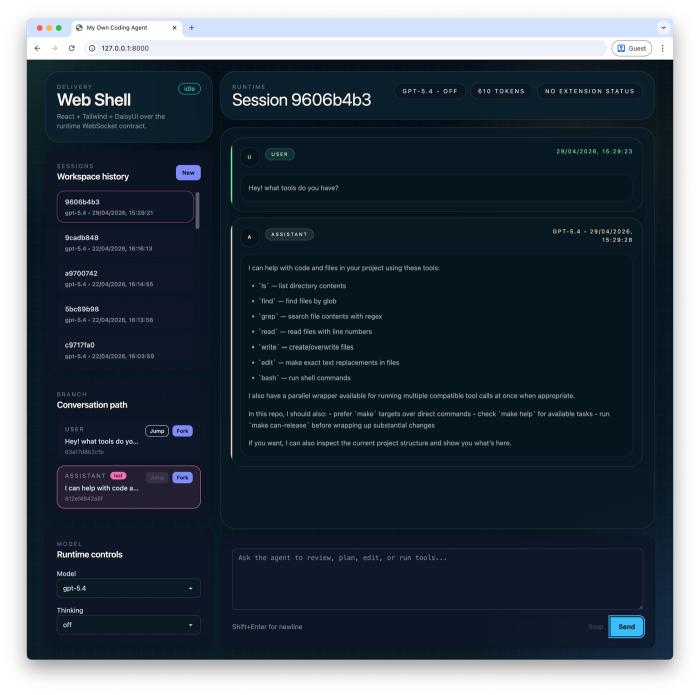
Granted it doesn’t handle every UI-specific use-case as it’s an abstraction, but for the 80% it does a great job. That’s also the reason an escape hatch was included, to handle any gnarly UI-specific integration.
I’ve been doing this work with Codex, which I’m finding to be a really good partner in crime for this kind of long-form re-architecture work. It works through compactions in a way that means I’m not constantly thinking about the context window size, which I still tend to do with Claude. From vibes alone, I’m also finding Codex more attuned to reaching for skills through normal conversation - whereas with Claude I tend to need to be explicit, either through slash invocation or very concrete requests. I’ve been very impressed with refactoring alongside an agent - being able to have high-level conversations whilst delving into some of the minutiae is very useful. For this re-architecture work I tried several different ideas in parallel across different (Forge) workspaces, and the design I landed on as a result I’m very happy with.
VoiceScribe
The other thing I had time for this week was VoiceScribe, my macOS dictation app. Another rethinking and re-architecting, though not really a refactor in this case - I was actually dropping functionality.
When I built VoiceScribe end of last year I added the OpenAI transcription path alongside the local one, and the same for the LLM cleanup pass. The thinking was I might need to fall back to the cloud for either of those. Turns out I never used either, and they were just bolt-ons sitting in the codebase. So I decided to drop them entirely and hone in on a local-only pipeline, since that’s what I actually use.
The big driver was Parakeet, which I’ve been seeing good things about over X. It tops the Hugging Face Open ASR Leaderboard at around 6% WER (beating Whisper-v3) at a fraction of the size, and via FluidAudio’s Core ML build on the Apple Neural Engine it runs at roughly 110x real-time - around half a second to transcribe a minute of audio. Whisper was already good, but Parakeet feels even better, and I’m really enjoying using it now.
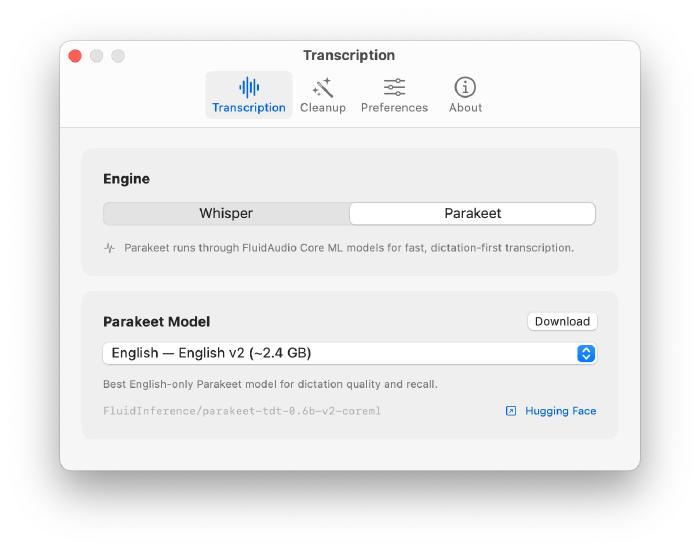
I also refreshed the optional cleanup pass options, all running through MLX, with Qwen3 1.7B, Llama 3.2 3B, and Qwen3 4B giving a good balance of speed and cleanup quality.
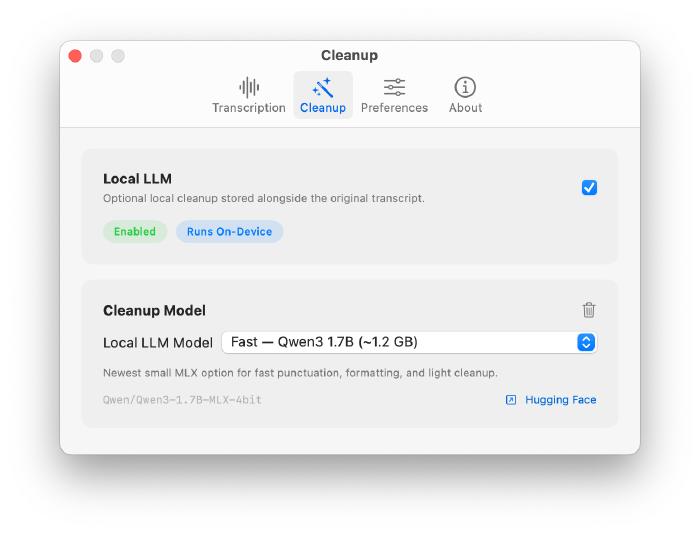
This redesign also gave me a chance to explore The Composable Architecture (TCA) by Point-Free.
TCA is a Swift library inspired by Redux and Elm: a single State value type, an Action enum for every event, a Reducer that evolves state and returns side effects as values rather than performing them inline, and a Store driving the whole thing.
The flow is unidirectional (State -> View -> Action -> Reducer -> State), and very functional-style in feel.
The Redux comparison was the one that resonated with me coming from React: you describe state, side effects are values, and SwiftUI handles the diffing and re-render in the same way React’s reconciliation does.
I really liked this way of thinking: update state, don’t worry about the diff, follow the data flow in one direction.
What I’ve Been Learning From
Videos/Podcasts:
- State of the Claw - Peter Steinberger’s 5-month update on maintaining OpenClaw, the fastest growing open source project in history (AI Engineer)
- Running LLMs on your iPhone: 40 tok/s Gemma 4 with MLX - Adrien Grondin of Locally AI (AI Engineer)
- Taste & Craft: A Conversation with Tuomas Artman - Linear’s CTO and Gergely Orosz on shipping quality and the zero-bug policy at Linear (AI Engineer)
- Full Walkthrough: Workflow for AI Coding - Matt Pocock workshop on running coding agents with TDD and tracer-bullet vertical slices (AI Engineer)
- I didn’t like OpenClaw so I built a better version - Chris Raroque on building a custom AI agent over iMessage
- GPT 5.5 Arrives, DeepSeek V4 Drops, and the Compute War Intensifies - AI Explained on the joint releases and recursive self-improvement
- Designing Data-intensive Applications with Martin Kleppmann - Kleppmann on the second edition of DDIA, his career, and modern infrastructure tradeoffs (Pragmatic Engineer)
- The Big LLM Architecture Comparison - Sebastian Raschka comparing 2025 open-weight LLM architectures (DeepSeek V3, OLMo 2, Gemma 3, Mistral Small 3.1, Llama 4)
- A Brief History of the LISP Programming Language (Part One) and (Part Two) - Stumbling Towards Something Different on Lisp’s history and modern implementations
- The Rise & Fall of LISP - Gavin Freeborn on the history of Lisp and why it lost popularity by the 2000s